
You know that AI can process information at lightning speed, but can you trust AI to read construction documents accurately? The answer to that question is what separates a useful tool from a potential liability.
There’s a version of AI document processing that sounds like a dream but works like a nightmare. You feed it a 400-page spec set, it spits out every quantity, date, and scope item in seconds, and you take it at its word. Fast, clean, done.
That is, until the bid goes out with a number that was never in the documents.
The uncomfortable truth about AI extraction is that speed without verification leads to expensive mistakes. The technology that pulls data out of your documents is only as trustworthy as the verification layer that checks it. And for a construction firm putting real money on the line with every bid, human verification is a feature, not a bug.
This is the case for keeping a human in the loop as a permanent, deliberate design choice.
The Problem Nobody Markets: Confident, Well-Formatted, And Wrong
AI extraction tools have gotten genuinely good. Peer-reviewed work on AI-assisted extraction reports strong accuracy, and studies of AI-in-the-loop systems find that domain experts working alongside the AI improve both efficiency and accuracy over either approach alone. That’s impressive. It’s also exactly the problem.
When a system is right 97% of the time, it gets harder to catch the 3%. Good data and bad data both arrive in the same clean, confident format. As one analysis of AI in business data put it, this creates a dangerous inversion: without human review, there is no reliable way to distinguish a confident correct answer from a confident hallucination. Automated format and range checks don’t catch it either, because they cannot detect errors that are plausible and well-formatted but factually wrong.
That’s the failure mode that matters in preconstruction. A hallucinated quantity isn’t a typo you’ll notice. It’s a plausible-looking number sitting in your takeoff, indistinguishable from the forty correct numbers around it, that is, until it shows up as lost business opportunities or a hit to your margins.
The cost of this is already being measured. According to Forrester, employees now spend an average of 4.3 hours per week verifying AI outputs, at an annual cost of roughly $14,200 per employee for hallucination verification and mitigation. Human verification isn’t optional overhead. It’s the work that makes the speed safe — and firms are already paying for it whether or not their tools are designed to support it.
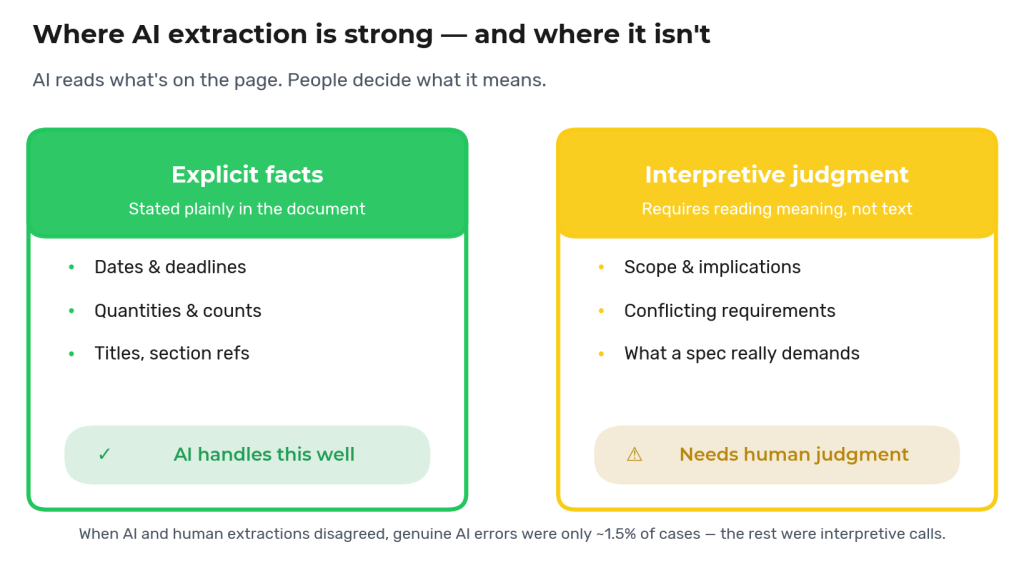
Here’s the nuance that makes the human-in-the-loop case airtight. A peer-reviewed study comparing AI and human data extraction across 187 documents found that AI extraction was highly consistent with human responses for concrete questions explicitly stated in the source — titles, dates, stated aims — and lower for questions requiring subjective interpretation. Strikingly, when AI and humans disagreed, genuine AI inaccuracies accounted for only about 1.5% of cases; the bulk of the disagreement came from interpretive differences — multiple defensible answers, different levels of detail, and minor classification calls.
The TL;DR is this: AI is excellent at finding what’s explicitly there. It’s weaker where judgment is required, which is precisely the work a skilled estimator is paid for.
For Leaders, This is a Risk and ROI Decision
If you run a construction firm, the trust question isn’t hypothetical. You’re being asked to put AI between your documents and your bids, and the downside of getting it wrong lands squarely on the bottom line.
The challenges are real. The broader data should make any leader cautious about unverified automation. Stanford’s AI Index documented 233 AI-related incidents in 2024 — a 56% jump over the prior year and the highest annual count on record. Public trust in AI is moving the wrong way even as adoption accelerates. And there’s a telling gap in how people see it: in Stanford’s 2026 data, 73% of experts expect AI to have a positive impact on how people do their jobs, compared with just 23% of the public. That’s a 50-point divide.
That gap is telling. The experts aren’t more optimistic because they trust AI blindly. They’re more optimistic because they understand that well-designed AI is governed AI. The firms that win with this technology will be the ones that implement human-led systems with oversight, traceability, and a human check on the outputs.
Here’s what a verification layer buys you:
- Defensible bids. Every extracted figure traces back to the exact source page, so when someone asks, “where did this come from?”, the answer is just one click away.
- Risk you can actually see. Low-confidence extractions get flagged and routed for review instead of flowing silently into your estimate. You’re reviewing the 5% that needs eyes, not blindly trusting 100% or manually re-checking everything.
- Speed that’s safe to keep. The time savings are real, but they don’t come at the cost of accuracy you can’t verify. You get the hours back and the audit trail.
The ROI math is simple. AI does the finding, your people do the verification, and that combination is faster and more accurate than either alone. And more bids mean more business.
For Estimators, the Loop Makes Your Job Easier, Not Redundant
If you’re the estimator, you probably hear AI document review and wonder what this actually means for your work.
The verification layer exists because your judgment is the valuable part. The system is built to take on the parts of estimating that aren’t really estimating. You shouldn’t be spending Thursday afternoon scrolling through 400 pages to find every flooring spec. The technology does the scrolling. You do the deciding.
Here’s how this workflow actually looks in practice:
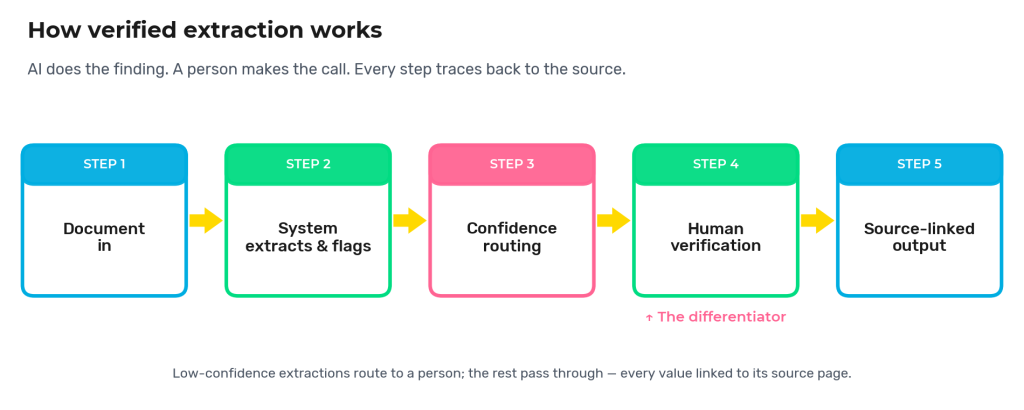
The AI reads everything and pulls out quantities, dates, scope items, and — critically — flags inconsistencies between documents. Anything the tool is unsure about gets surfaced to you rather than buried. You verify the flagged items, with every extraction linked straight back to the source page, so checking a number takes seconds – no chasing paperwork, no waiting for call backs. Checked for accuracy in the moment, what comes out the other side is structured and exported, with traceable sources.
What changes for you isn’t that you stop reviewing. It’s what you review. Instead of reading everything to find the few things that matter, you go straight to the things that matter — the conflicts, the ambiguities, the judgment calls. The research backs this up: the work AI struggles with is exactly the interpretive work that was always yours.
And there’s a quieter benefit. When the system flags an inconsistency between a drawing and a spec — the kind of conflict that’s easy to miss on page 280 of a long set — it’s catching the thing that could cost you money. Human verification covers your blind spots, on your terms, with you making the final call.
Human-in-the-Loop by Design
There’s a common assumption that human verification is just a temporary workaround we have to endure until the models get good enough to trust completely. That’s the wrong mindset, and the data shows why.
The accuracy problem isn’t going to fully disappear, because the hardest cases aren’t accuracy failures at all — they’re interpretation. When two readings of a spec are both defensible, there’s no model confidence score that can resolve that. That’s a judgment call, and judgment is a human contribution by definition.
This is why Pivotly is being built around verification rather than circumventing it. That’s the real differentiator can you verify it, fast, every time? A tool that extracts in seconds and links every answer to the page it came from, flags what it’s unsure of, and puts a skilled human at the decision point — that’s a tool a construction firm can actually bet their business on.
Sources
- Tendem AI, “The True Cost of AI Hallucinations in Business Data,” 2026 (citing Forrester verification-time data) — https://tendem.ai/blog/true-cost-ai-hallucinations-business-data
- Gin et al., “Hallucination vs interpretation: rethinking accuracy and precision in AI-assisted data extraction for knowledge synthesis,” arXiv, 2025 — https://arxiv.org/pdf/2508.09458
- Stanford HAI, “AI Index Report 2025” — https://hai.stanford.edu/ai-index/2025-ai-index-report
- Stanford HAI, “2026 AI Index Report” (expert vs. public trust gap) — https://hai.stanford.edu/ai-index/2026-ai-index-report
- Microsoft Learn, “Document analysis with confidence, grounding, and labeled samples” (confidence-based routing and source grounding) — https://learn.microsoft.com/en-us/azure/ai-services/content-understanding/document/analyzer-improvement
- KnowledgeShovel, “An AI-in-the-Loop Document Annotation System for Scientific Knowledge Base Construction” (domain experts improve both efficiency and accuracy with AI-in-the-loop extraction), arXiv — https://arxiv.org/pdf/2210.02830