
You have probably seen handoff checklists used for one moment in construction: closeout. Warranties, punch lists, O&M manuals, the paperwork that happens when a job wraps. But there is another handoff that gets almost no attention, and it happens the moment you win the bid.
That is the moment your schedule of values stops being an estimating tool and becomes the record everything else gets built against. The PM builds the schedule from it. The superintendent tracks progress against it. Accounting bills draws off it, retainage gets calculated against it, and lien waivers get chased line by line to match it. If the SOV that leaves your desk is wrong, coded sloppy, or missing scope, that error does not stay in estimating. It rides along into every system that touches the job.
You know this already if you have ever gotten a call three weeks into a job asking where a scope item went. This checklist exists so that call stops happening.
The Estimating Handoff Checklist
Run this before a bid becomes a job. Not after the PM asks for it.
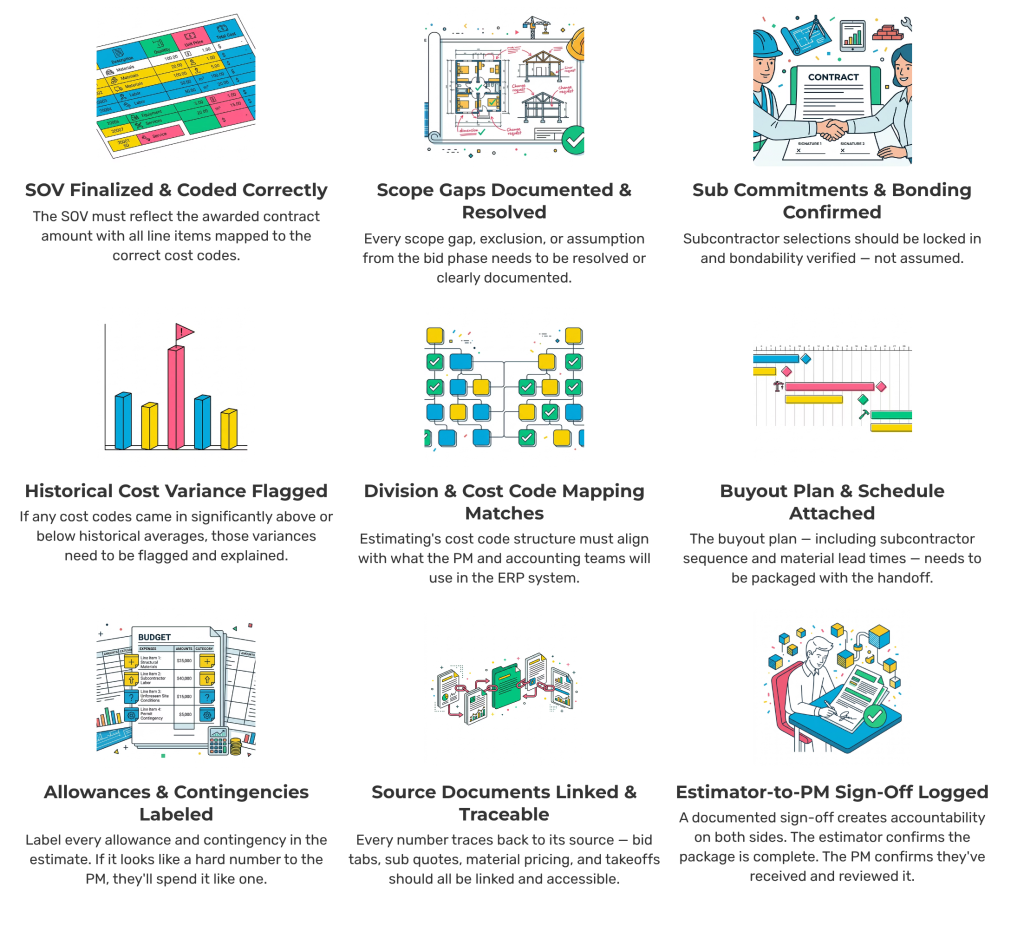
- SOV finalized and coded correctly. Line items match your final cost codes, not a rough draft from three revisions ago. When you export the schedule of values into your PM tool or ERP, the codes should already match on both ends, not need translation after the fact. If your ERP uses a different code structure than your estimate, resolve it now, not after the PM builds a schedule around the wrong numbers.
- Scope gaps closed out. Every scope item from the plans and specs has a home in the SOV. No “we will figure that out later” line items. Gaps that leave estimating become someone else’s discovery, usually mid-job, usually expensive.
- Sub commitments and bonding confirmed. The subs you carried in your bid are the subs who can actually perform at the bonding limit the job requires. Confirm this before handoff, not when buyout starts and you find out your low bidder cannot bond the job.
- Historical cost variance flagged. If a line item came in noticeably different from what similar work has cost on past jobs, flag it. Do not just move on. The PM inheriting this job has no way to know your number looks off unless you tell them.
- Division and cost code mapping matches PM and ERP structure. Estimating and project management should be looking at the same job through the same code structure. If they are not, every report downstream is comparing numbers that do not actually line up.
- Buyout schedule attached. Hand off more than a bid number. Hand off the sequence: what gets bought first, what has long lead time, what buyout decisions were already made during the bid. The PM should not be rebuilding buyout strategy from scratch.
- Allowances and contingencies labeled. Mark every allowance and contingency clearly, with the assumption behind it. An unlabeled allowance looks like a firm number to everyone downstream, and it gets treated like one until someone spends it.
- Source documents linked and traceable. Every number in the SOV should trace back to the plan sheet, spec section, or sub quote it came from. When a number gets questioned in month four, someone should be able to find the source in minutes, not by digging through your email.
- Estimator-to-PM sign-off logged. A real handoff, not an email that says “attached, let me know if questions.” Someone confirms the SOV was received, reviewed, and accepted before the job starts running against it.

Live webinar · Register or watch on demand
See the full leveling workflow walked through on real bid docs, start to finish.
Access the webinar