
A security and technology installation firm with a decade of work across residential, commercial, and government projects replaced a multi-pass manual bid review with bid management software that reads the documents for them — and started catching inconsistencies that used to slip through.
At a glance • Company: KMSS — professional services in security and technology installation (residential, commercial, and local/state/federal government) • Challenge: Reviewing every bid’s plans, specs, and addenda by hand — once to bid, once again after award • Solution: Pivotly’s Parse tier, used as bid management software with an AI document-parsing workflow • Result: Initial bid document review cut by nearly half, with inconsistencies surfaced before bids went out |
The problem: every bid meant reviewing the same documents by hand, twice
Before Parse, KMSS had a bottleneck familiar to almost any team that bids on document-heavy projects with disconnected tools. Every opportunity arrived as a stack of unstructured documents — plans, specifications, addenda, equipment schedules, and full bid packages — and someone had to read all of it by hand to build the bid.
Then, if the bid was awarded, they read all of it again to scope the work. The same specs. The same addenda. The same equipment schedules. Reviewed manually, start to finish, a second time. Most bid management software still leaves this first step — turning documents into usable data — sitting on a person, because the details live only in the PDFs and in the estimator’s head.
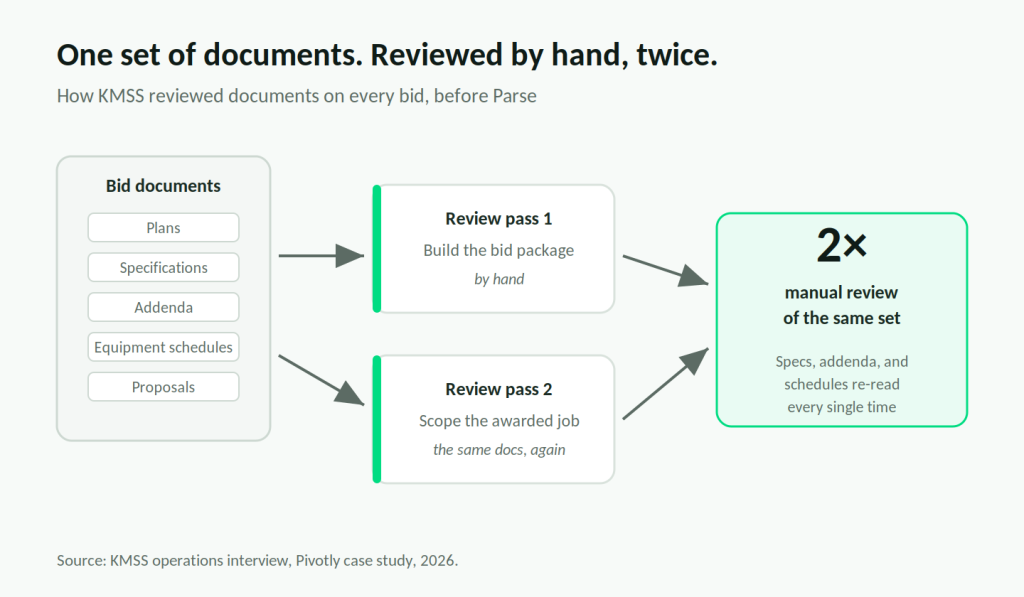
Figure 1. Before Parse, KMSS reviewed the same documents by hand to build each bid, then again to scope the awarded work.
KMSS came in with a fair question: would an automated tool actually capture their specific divisions accurately across both the uploaded plans and the specification documents? Security and technology installation scope is easy to get wrong if a bidding tool treats every division the same way.
Why Bluebeam wasn’t enough
KMSS had worked with tools like Bluebeam before, so the gap they were solving for wasn’t measurement or markup — it was extraction. Bluebeam is built for marking up plans and running takeoffs on a document a person is already reading; it assumes a human is in the seat, doing the interpreting. That sped up parts of the manual review without removing it. Someone still had to open each document, find the relevant scope, and carry the numbers forward by hand — then do it again after award. Parse addressed the step underneath that, turning the documents into structured, traceable data in the first place. In Jesse’s framing, that’s the difference: Parse let them automate all aspects of bidding, not just the annotation on top of it.
Why Bluebeam wasn’t enough
KMSS had worked with tools like Bluebeam before, so the gap they were solving for wasn’t measurement or markup — it was extraction. Bluebeam is built for marking up plans and running takeoffs on a document a person is already reading; it assumes a human is in the seat, doing the interpreting. That sped up parts of the manual review without removing it. Someone still had to open each document, find the relevant scope, and carry the numbers forward by hand — then do it again after award. Parse addressed the step underneath that, turning the documents into structured, traceable data in the first place. In Jesse’s framing, that’s the difference: Parse let them automate all aspects of bidding, not just the annotation on top of it.
The solution: bid management software that reads the documents first
Pivotly set KMSS up on the Parse tier — bid management software built around an AI document-parsing workflow that turns bid PDFs into structured, traceable data instead of leaving it locked in the source files. It replaced the scattered spreadsheets and shared drives that most bid management software still leaves teams to maintain by hand:
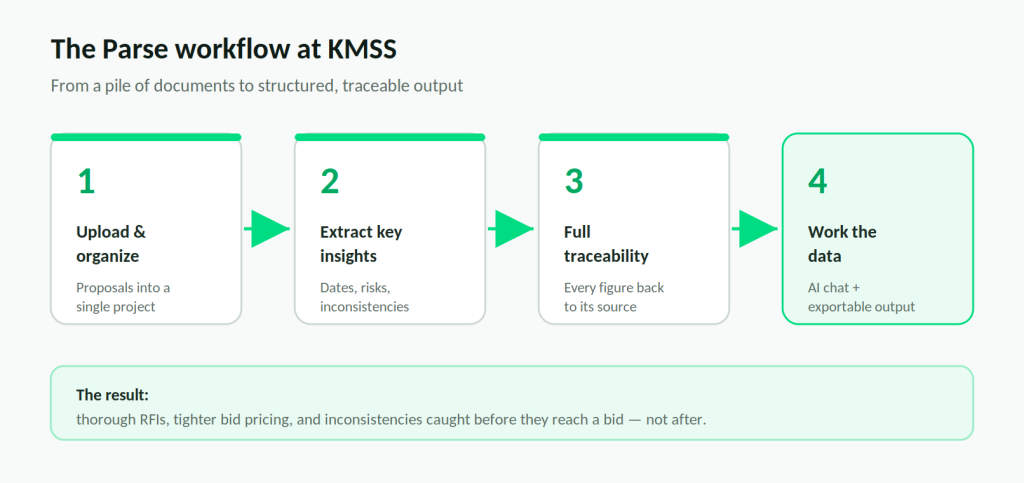 Figure 2. The Parse workflow: upload and organize, extract insights with full traceability, then work the structured bid data through AI chat and exportable output.
- Upload and organize subcontractor proposals and project documents into a single project — the subcontractor management piece that used to live in scattered folders and email threads.
- Extract the key insights — dates, risks, and inconsistencies — using AI, with full traceability back to the source document.
- Work the data directly through AI chat and structured, exportable outputs, instead of re-keying it into a spreadsheet.
The traceability piece is what made the difference for a scope-sensitive firm. Every extracted figure could be traced back to where it came from in the plans or specs, so estimators could trust the output and still verify it. And because subcontractor proposals lived in one organized project rather than scattered inboxes, the subcontractor management side of bidding got easier too — the human stays in the loop, but stops being the human middleware between documents and the bid.
We were initially concerned about just how accurately our specific divisions would be captured within both uploaded plans and specification documents. However, once we started using it, we immediately saw how valuable a resource it was. It cut our initial time spent reviewing documents by nearly half. — Jesse Emerson, Director of Operations, KMSS |
The impact: initial bid review cut by nearly half
The headline result is time. KMSS reported that Parse cut their initial document review time by nearly 50% — hours that moved off manual reading and back onto the estimating work that actually decides whether a bid wins.
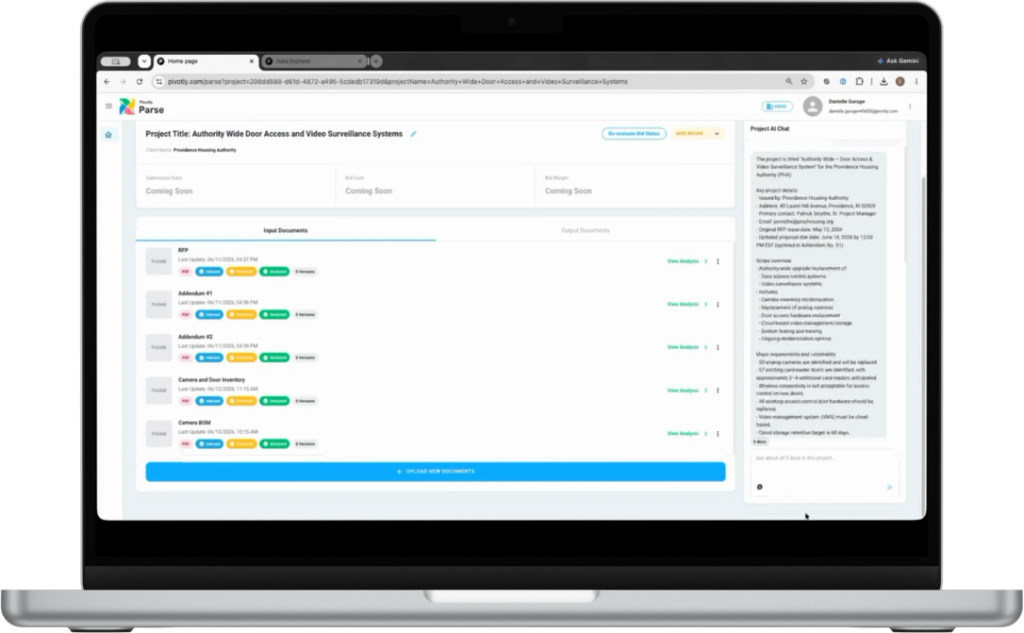
But the time savings were only part of it. Because Parse extracts and structures the data with traceability, it also surfaced inconsistencies in bid documents and RFP packages that manual review would have missed entirely. That changed what KMSS could do downstream: more thorough RFIs, tighter bid pricing, and fewer surprises after award. For a team that had leaned on generic RFP tools and markup software, having the extraction handled natively was the difference.
What changed for KMSS • Extraction solved: bid documents become structured data instead of a manual reading job • Review time cut by nearly half on the initial bidding pass • Inconsistencies surfaced that hand review would have missed — enabling more thorough RFIs and more accurate bid pricing • A workflow catered to their scope, backed by a responsive team focused on optimizing the system for their specific divisions |