
Your estimating team is not slow. Your process is.
Most pre-construction teams at mid-market GCs are running the same hidden operation: one person receives a subcontractor quote, pulls out the numbers by hand, reformats them into a spreadsheet, and re-enters them into whatever system the firm actually uses for tracking. Then someone else checks the work. Then the spreadsheet gets emailed around. Then someone updates it again when a number changes.
Let’s be honest about this. This was never the plan. Nobody decided this was the process. It just became the process, because the tools never talked to each other and somebody had to make them.
That somebody is your senior estimator, doing the job of human middleware. And that work is your middleware tax.
What “Human Middleware” Actually Means
In software, middleware is the layer that sits between two systems and translates information from one format to another. It is invisible infrastructure that makes integration possible.
In most mid-market construction firms, that layer is a person. They receive a PDF. They open a spreadsheet. They type. They check. They send it somewhere. The tools on either side of that person were built to store and process clean, structured data. The documents coming in — RFPs, sub quotes, bid packages — are not clean or structured. So a human sits in the gap and converts one into the other.
This is human middleware. And it is expensive in ways most firms do not measure directly.
The direct cost is straightforward once you calculate it: an estimator making $85,000 to $110,000 a year, spending 30 to 40 percent of their time on manual extraction and re-entry, is carrying a data-entry workload under an estimator’s title. That is roughly $25,000 to $44,000 per year, per person, in compensation alone — paid for hours that could be going toward winning bids instead of re-keying them.
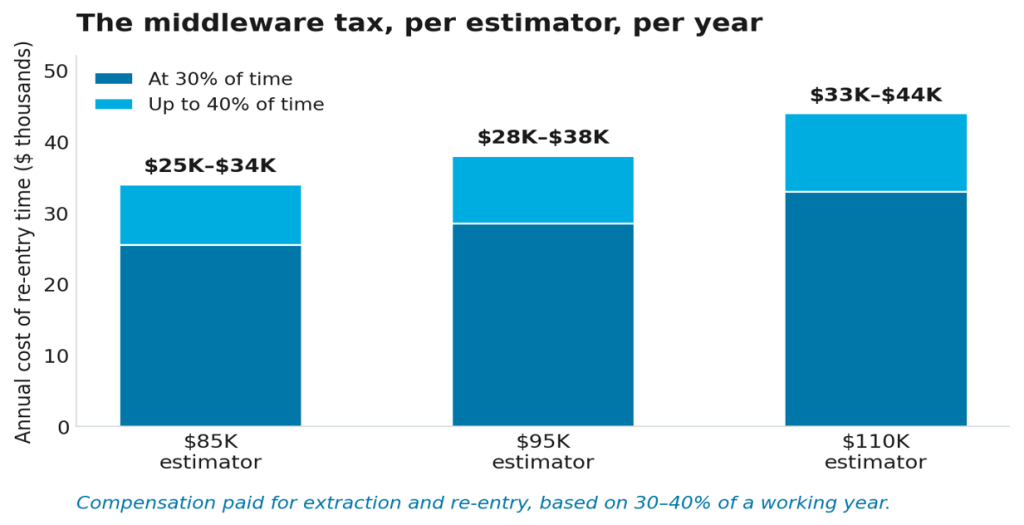
Figure 1. The annual cost of re-entry time, per estimator, at 30–40% of a working year.
The indirect costs are harder to see but larger in aggregate. Errors introduced during manual re-entry. Bids that take longer than they should, which means fewer bids run per cycle. Context that never gets captured at all, because there was no clean place to put it and no one had time to build one.
The Problems with Disconnected Systems — in Construction Specifically
The problems with disconnected systems in business are not unique to construction. But construction has a version of it that is particularly punishing.
Pre-construction work lives almost entirely in unstructured documents. RFPs arrive as PDFs. Sub quotes come in as Excel files formatted differently by every trade. Bid packages are assembled from dozens of source documents that were never designed to be compared against each other. The information is real and valuable — it just does not arrive in a format your software can use.
So teams build workarounds. A master bid-tracking spreadsheet that someone owns. A shared drive full of old proposals that no one can search effectively. An informal system where the most experienced estimator becomes the institutional memory, because there is nowhere else to put what they know.
These workarounds hold until they don’t. A key person leaves. A new estimator joins and starts from scratch. Bid volume climbs and the manual process becomes the ceiling on what the team can handle.
The chart below shows where pre-construction time typically goes at a mid-market GC. The ranges come from estimator and pre-construction interviews and reflect variation across GCs doing $5M–$75M in annual revenue.
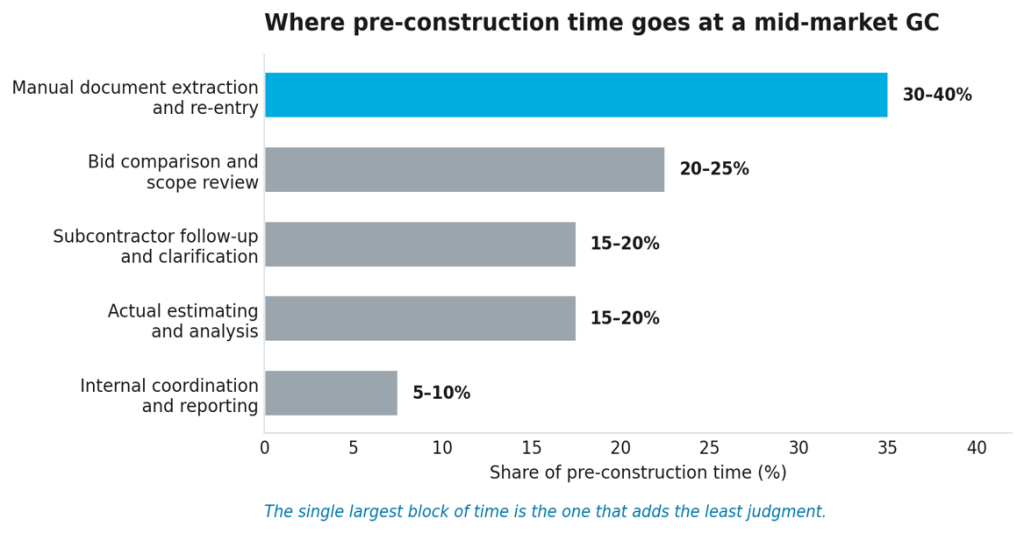
Figure 2. Pre-construction time allocation at a mid-market GC. Ranges reflect $5M–$75M annual revenue firms.
When you look at that breakdown, the most expensive line item is also the one that adds the least judgment. Manual extraction is not estimating. It is not analysis. It is not relationship work. It is conversion — taking information from one format and putting it in another — and it sits directly on top of the people whose time is worth the most.
What the Tax Costs at Scale
Zoom out from a single estimator and the pattern compounds. Bad, disconnected data is not a filing inconvenience — it is a measurable drag on the whole industry.
A firm re-keying numbers between tools is manufacturing exactly the kind of data that study measured: a quantity that was right in the sub quote and wrong in the tracker, an addendum that updated one file but not the other, a scope note that lived only in one estimator’s head. Every manual handoff is a place for a number to drift.
Every manual handoff between tools is a place for a number to drift — and drift is what shows up later as rework.
For a mid-market GC, the firm-level version of the tax can have real consequences. It is the bid that went out with a stale number, the buyout that referenced the wrong revision, the change order that traced back to a figure typed twice. None of those failures started out as dramatic events. It’s just the inevitable consequences of having your people moving data by hand.
Why “Just Integrate It” Has Not Fixed This
The obvious response is to connect the tools. Integration platforms exist precisely to move information between systems, and many firms have tried them.
The catch is what those tools require to work. This is where the system of record vs. integration distinction matters: integrations move data that is already clean and structured — a field in one system mapped to a field in another. They are built for information that already lives in a database on both ends.
Pre-construction data does not start that way. It starts as a PDF a subcontractor emailed, a spreadsheet formatted however that trade prefers, a set of plans with the real scope buried in the notes. Before any integration can move that information, someone has to turn it into structured data first. That first step — reading the document, pulling out what matters, and getting it into a usable shape — is the human middleware. It is the part integration was never designed to touch.
So in the end, the tax survives the integration project. The systems on either end connect, but your estimator is still stuck in the weeds, turning documents into data.
Reclaiming the Hours
Remember, the goal here is not fewer estimators. It is estimators spending their hours on the work only they can do.
When the extraction and re-entry layer is handled by a system rather than a person, the same team’s day changes shape. The hours that went into reading documents and typing numbers can now be spent on revenue-generating activities – scope review, takeoff, buyout strategy, and the judgment calls that decide whether a bid wins. The headcount is the same, but what it’s pointed at is different.
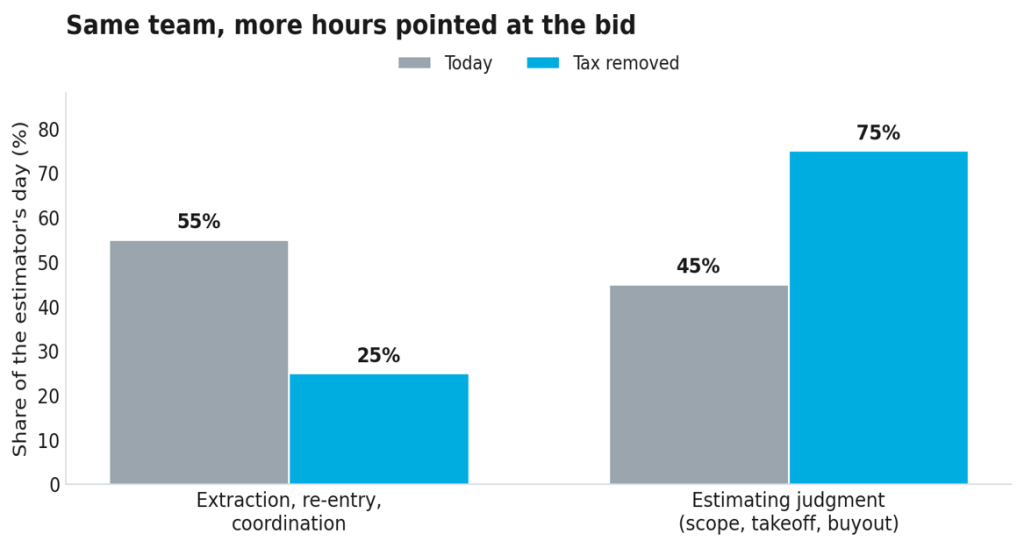
Figure 3. The same estimating team, before and after the middleware tax is removed.
Capacity is reallocated, not cut.
This is an important distinction. A firm does not need software to write estimates for it. Instead, it needs the connective layer beneath the estimators — the part that reads the incoming documents, pulls the numbers into a structured form, keeps them synced across the tools the firm already runs on, and holds onto the context so it stays searchable instead of walking out the door when someone leaves.
That is the difference between a pipe between systems and a system the business actually runs on — the difference at the heart of the system of record vs. integration question. A pipe, or integration layer, moves data that is already clean. A system of record does the work that used to require a person in the gap — and gives the firm back the capacity it was paying for all along.
Running the Numbers
Before your next planning cycle, it is worth putting a figure on this. Take an estimator’s fully loaded cost. Multiply it by the share of the week they spend extracting and re-entering data rather than estimating. Do it across the whole pre-construction team.
That number is your middleware tax. Whether you call it estimating or data entry, you are already paying for it. The question is, how much longer you want to.
Industry figures:
Autodesk & FMI, “Harnessing the Data Advantage in Construction” (2021).
Join our Workflow Automation Webinar
And get the executive playbook for implementing AI safely, guaranteeing 100% accuracy in your mission-critical workflow
Or, Take the Next Step:
No high-pressure sales pitch, just a practical plan to move forward.