
Nobody sits down and decides to give away their operational data. The question of who owns data in AI tools gets settled the way most structural problems get settled — one reasonable decision at a time, each one small enough that no single approval felt like it mattered.
A team needed a tool. The tool needed access. The access was scoped, reviewed, and granted. Then the same thing happened four more times, in four more departments, and now your operational data exists in more places than anyone can name, under terms nobody has read since signing.
The uncomfortable part is that every one of those decisions was defensible on its own. It is only the accumulation that creates exposure — and by the time anyone asks who owns data in AI tools across the whole estate, the answer is spread across a dozen contracts.
The status quo: a copy in every system
Here is the pattern almost every organization is running right now, regardless of industry.
Your systems of record are fine. Your ERP works. Your document repository works. Your CRM works. They were selected carefully by people who understood the requirements, and they do what they were bought to do.
The difficulty lives in the space between them — and that space is currently occupied by people doing manual work, plus a growing collection of tools brought in to make that manual work faster. Each of those tools needs your data to function. So it gets a copy.
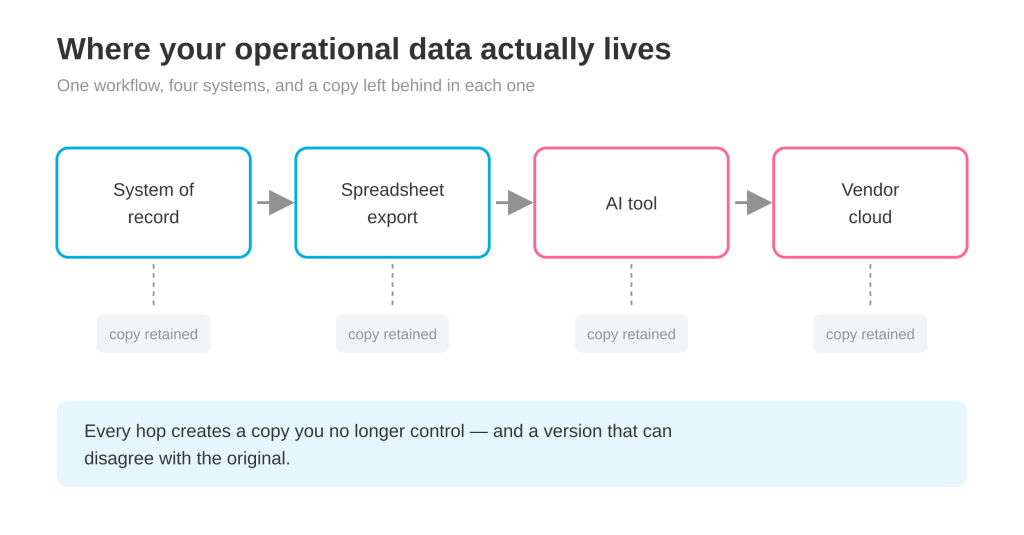
One workflow, four systems, four retained copies.
The copying looks small each time. It happens on every run, it is performed by your most expensive people, and every instance is a chance for two systems to disagree about what is true.
But the operational cost is only half of it. The other half is that you have distributed your data across vendors whose terms you accepted individually, and whose retention practices you have never compared side by side.
The question is not whether your data is safe. It is whether you could get all of it back, in usable form, if you left tomorrow.
Who owns data in AI tools, according to the terms of service
AI tooling made this pattern sharper, because AI tools are hungrier. A traditional integration moves a record from one place to another. An AI tool ingests documents, context, corrections, and edge cases — the accumulated judgment of your most experienced people, expressed as training signal.
That is genuinely valuable, and not only to you. Some vendors are explicit about how they use it. Others bury the answer in a subprocessor list. A few offer opt-out, which quietly tells you what the default is.
Three specific things determine who owns data in AI tools, and all three are worth knowing before any tool touches production data:
- Whether your inputs are used to train models that serve other customers, by default or by exception.
- Who owns the structured output the tool produces — which is often treated differently from the source data you provided.
- What happens at termination: what you can export, in what format, on what notice, and whether deletion is confirmed in writing.
None of this requires suspicion of any particular vendor. It requires reading the contract as carefully as you read the security questionnaire, because ownership is a contractual property, not a technical one.
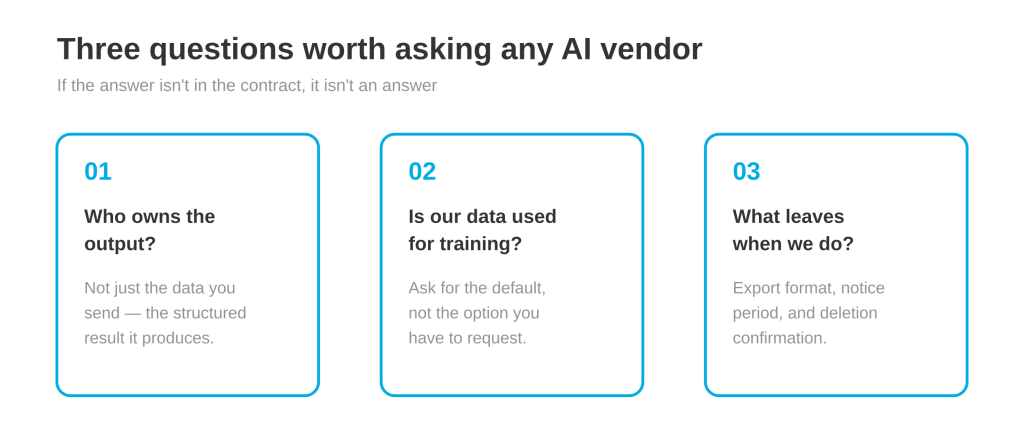
If the answer is not in the contract, it is not an answer.
AI tool data ownership is architectural before it is legal
Contract language matters, but architecture determines how much the language has to carry.
When a tool works by pulling your data into its own environment, ownership becomes a promise — one you are trusting a vendor to keep, and one you can only verify by asking. When a tool works inside the environment you already control, ownership is closer to a physical fact. The data never left. There is no copy to reclaim, because no copy was made.
That distinction shows up in unglamorous places: whether you can answer an auditor without emailing a vendor, whether a switching decision takes a weekend or a quarter, and whether your leverage at renewal comes from the contract or from the fact that you could actually walk.
The connected alternative
Pivotly was built for the second model. It operates as a shared data layer across the systems you already run — reading from them, verifying what it extracts, governing what moves, and syncing results back into the systems where the work actually lives.
Your data stays in your environment, under your controls. Pivotly does not use customer data to train models. The structured output belongs to you the same way the source data does — and if you leave, you leave with everything, because everything was already yours and already where you keep it.
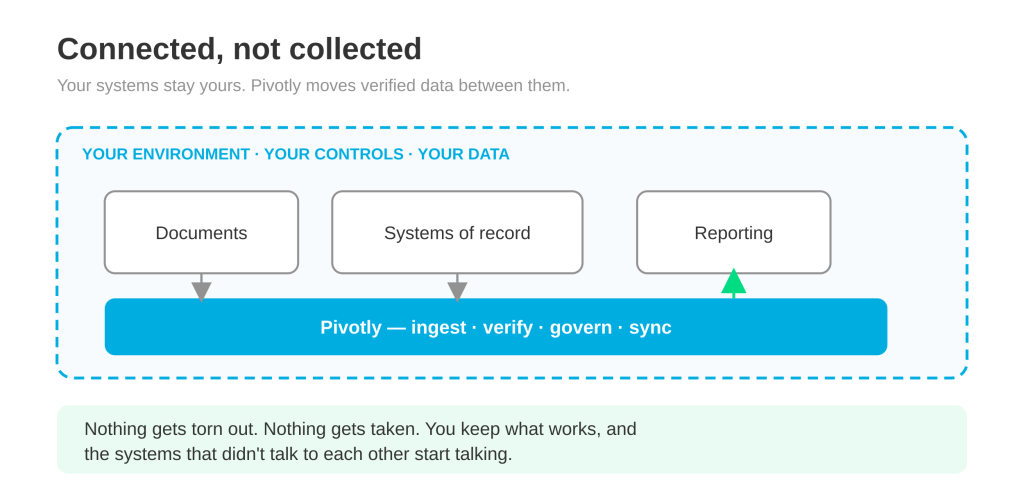
Connected, not collected.
The practical result is that adopting Pivotly does not add another vendor to the list of places your data lives. It reduces the manual movement between the places it already lives — typically cutting manual data movement by 60 to 80 percent — without asking you to hand custody of anything to anyone.
Keep what works. Connect what does not talk. Nothing gets torn out, and nothing gets taken.
How to answer this for your own stack
You do not need a formal data ownership strategy to make progress here. To find out who owns data in AI tools across your own stack, you need an inventory and three questions.
- List every tool with production data access. The number is usually higher than expected, and finding it out is the whole first step.
- For each one, answer the three questions above from the contract — not from the marketing site, and not from memory.
- Sort the results into what you would keep, what you would renegotiate at renewal, and what you would replace.
That exercise tends to be clarifying on its own. Most organizations find one or two arrangements they would not sign again, and a handful they simply never looked at closely.
If you would like help mapping where your data moves and where copies accumulate, a Data Workflow Audit does exactly that — a structured walk through your current flows, with no obligation and no access required to run it.