
Subcontractor management software shows you every system. It does not always show you the sub. Here is where that gap turns into real exposure on your jobs, and what it takes to close it.
A subcontractor’s certificate of insurance expires on a Tuesday. Your subcontractor management software catches it that night and flags the record. Accounting never hears about it.
Thursday, the sub’s pay application moves through its approval chain. The project manager verifies stored materials, retainage holds where it should, the draw gets packaged with the rest of the month’s payables, and the check releases to a firm carrying no active coverage on a job that is currently in framing.
Everyone did their job right. Every system was correct about what it held. Two systems just had two different versions of the same fact, and the payment run got there first.
You will not close that gap with another reminder email. It lives in the space between the tools you already run, and that is exactly where it is hardest to see. A precon director running thirty jobs can see into every one of those tools. What nobody can see is the sub.
Where the subcontractor record actually lives
Ask a GC to pull everything their subcontractor management software knows about one sub, and watch what happens. Five systems open.
- Prequalification platform. Financials, bonding capacity, EMR, safety history, project and aggregate limits, references, and the date somebody signed the questionnaire.
- Bid and ITB tool. Which trade packages the sub bid, scope inclusions and exclusions, addenda they acknowledged, coverage across your active pursuits. Leveling lives here too, as one input among several (Pivotly preconstruction bidding buyer’s guide).
- Project management system. The subcontract exhibit, submittal turnaround, RFI volume, manpower counts on the daily logs, change order history.
- Accounting and ERP. Pay applications, retainage held, lien waivers in and outstanding, joint check agreements, payment history.
- Document repository. The COI itself, endorsements, W-9, safety plan, the signed subcontract, and whatever landed as an email attachment in a folder somewhere.
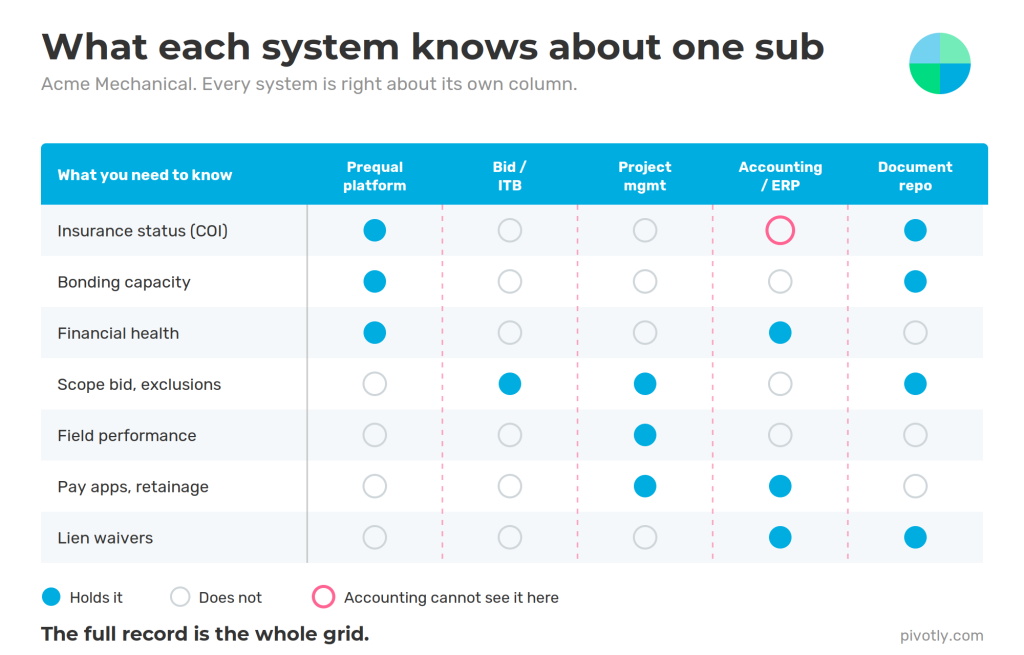
Every one of those systems does its job well. None was built to talk to the other four. That is why subcontractor visibility in construction keeps getting solved with another dashboard that keeps coming back as five partial ones.
Somebody in precon usually holds the rest in their head. They know Acme Mechanical is stretched thin because of a phone call back in May, and they check that against a spreadsheet they keep themselves. That is real, skilled work, and it disappears the week they are on vacation. We call it the human middleware tax, and you pay it in hours that never show up on a job cost report.
What subcontractor management software controls, and when
Prequalification, financial vetting, and COI collection are entry checks. A sub clears them once to get on the bid list, then again at renewal. In between, nobody is watching.
That timing is where the risk lives. Your controls are tightest the day a sub joins the bid list, and quietest the day something starts going wrong on a job.
AGC and FMI’s 2024 research found 70 percent of firms reporting more subcontractor distress or defaults than the year before, and close to half reporting project disruptions because of it. A sub who looked fine in January can be in real trouble by August, and the paperwork will not catch it until next January.
Most of the early signs are already sitting in your systems. Submittal turnaround slips from four days to eleven. Manpower on the daily logs comes in under the schedule commitment two weeks running. Change orders start showing up on scope that was priced as complete. A sub asks to shorten payment terms or release retainage early. Each of those lives in a different system, gets read by a different person, and none of them is loud enough alone to raise a flag.
Every one of those gaps carries exposure on your side of the contract. An uninsured sub working an active site. A sub holding more of your backlog than their bonding supports. Waivers outstanding on a job heading into closeout. A draw released to a firm that may not be there to finish the work. All four are catchable early when the record is current across all five systems at once.
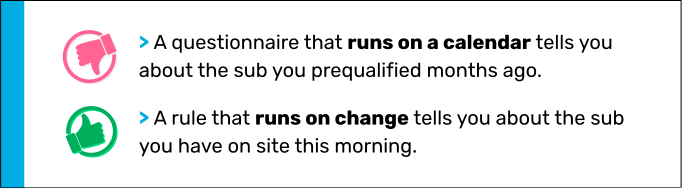
Subcontractor risk management only works if it runs all the time, on every job, every day, not once a year.
One record, four steps: Ingest, Verify, Govern, Sync
Pivotly is a shared data layer. It connects the systems you already run, ERP, CRM, prequal and bid tools, document repositories, and APIs, into one record per sub. Nothing migrates. Procore stays Procore. Sage stays Sage. Here is what that looks like for one sub.
Ingest. Pivotly pulls the sub’s records from every system that has one: prequal, bid, PM, accounting, and the folder where the COI actually lives.
Verify. “Acme Mechanical,” “Acme Mechanical Contractors LLC,” and vendor 4417 in accounting become one record. If two systems disagree on a number, you can see which one is right and click through to the document behind it.
Govern. This is where risk control actually lives. You set the rules once: coverage lapses, a bond is about to expire, backlog pushes a sub past their aggregate limit, waivers sit outstanding too long. Pivotly checks them every time something changes, not once a year. In the COI example, the rule is simple. No current coverage, no release. The pay application holds, the right people get notified with the COI attached, and someone makes the call. The rule does not make the decision. It makes sure the decision reaches a person while there is still time to act on it.
Sync. The resolved status goes back into the systems where the work happens. Accounting sees the compliance flag before the payment run goes out. The PM sees it on the sub’s record. Precon sees it before that sub lands on the next bid list. When something needs a person, it shows up as a short list on a phone, with the document already attached.
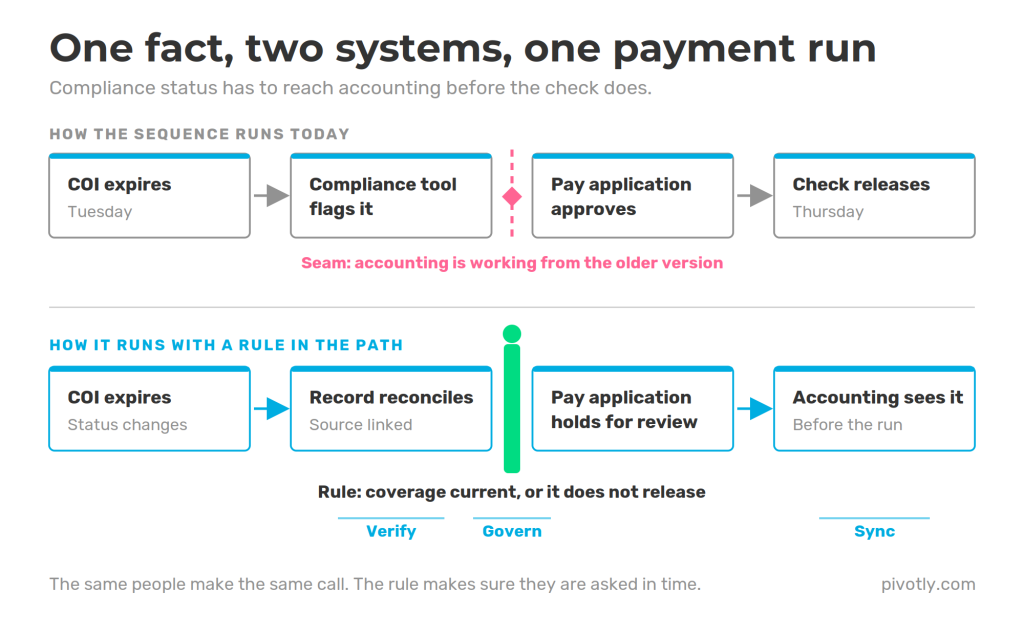
Compliance status has to reach accounting before the payment run does. The rule makes sure of that every time, on every job, whether or not anyone remembers to check.
What changes in practice
Firms working with Pivotly see 60 to 80 percent less manual data movement. The better number is where those hours go.
Your precon team stops piecing the sub together and starts using what they already know. Time that used to go into cross-checking five systems before a buyout meeting goes into qualifying second-tier coverage on the trades where you are thin, catching scope gaps on the packages with the most exposure, and calling the sub who is struggling in August instead of finding out in November. Same people. Better hours.
Three exposure questions get a lot easier to answer. How much work do we have with this sub right now, across every job, against their bonding limit? Which subs have coverage, a bond, or a waiver expiring this month, and which are trending the wrong way? And when the person who has kept all of this in their head retires, what is left behind?
Subcontractor compliance tracking runs in the background instead of eating a week every quarter.
None of this is a headcount conversation. Moving data between systems was never a job anybody was hired to do. Those hours go back to judgment calls, the part your people are actually good at.
Start with one seam
You don’t have to solve it all at once. Pick the handoff that costs you the most. For most GCs, that is compliance status reaching accounting, because that is the one with a check at the end of it. One seam, one rule, one system pair. Prove it holds, then take the next one.