

Construction bidding software gets you to a finished bid. What it doesn’t do is carry that bid data into the ERP, the CRM, and the three spreadsheets that never quite agree — that part is still done by hand. That re-keying is where the hours go, and where the errors start.
Construction bidding software has come a long way. Whether you run a dedicated bid management platform, an estimating suite, or a stack of point tools, the software gets you from a set of documents to a finished, priced, submittable bid faster than any manual process ever could. That is real progress, and it is worth paying for.
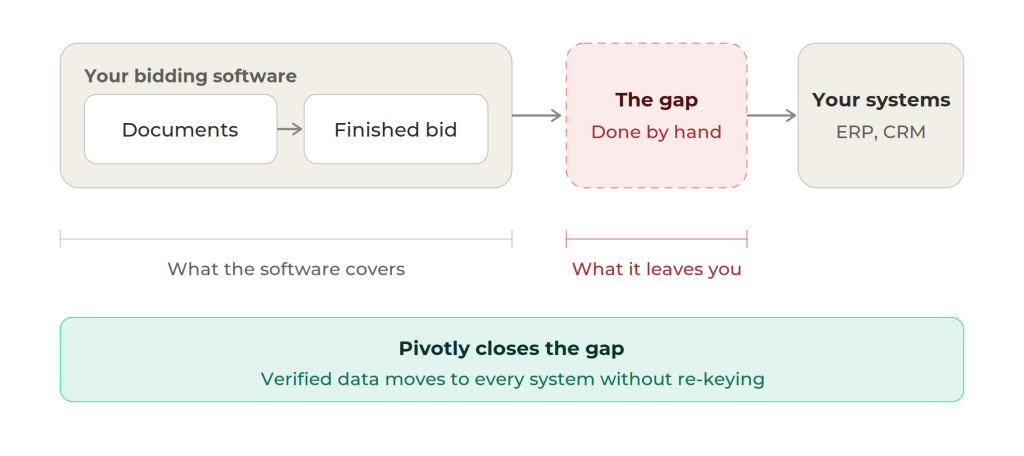
But watch what happens the moment the bid is done. The numbers that bidding software helped you build now have to reach everywhere else the business runs: the ERP that prices and tracks the job, the CRM that manages the pursuit, the accounting system, the project setup, the procurement list. Construction bidding software builds the bid. It does not carry the bid’s data across all of that — so a person does, by hand, one system at a time.
That is the gap this piece is about. Not which bidding software to buy — you may already have one you like — but what every bidding tool leaves undone once the bid is finished, and what it costs you on every job.
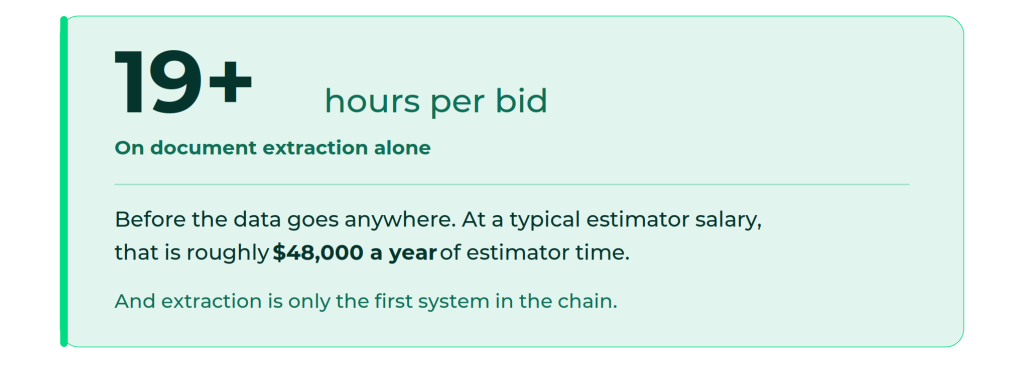
That figure is just the read — the work of getting data out of the documents in the first place. Bidding software helps compress it. But once the data is out and the bid is built, it still has to reach every other system that needs it, and today a person carries it there.
Independent research puts the wider problem in stark terms: preconstruction roles spend an average of 13.4 hours a week just researching and analyzing data (Deloitte Access Economics, commissioned by Autodesk, 2023), and knowledge workers across industries report more than nine hours a week moving data by hand out of PDFs, emails, and spreadsheets into other systems (Parseur, 2025). A construction bid is exactly that kind of document problem, only denser and higher-stakes.
Mistakes happen! And many of those errors do not originate in the field. They originate upstream, in the moment a correct number gets transcribed into the wrong cell of the wrong system. Bad data has to enter somewhere. The manual movement of bid data between tools is one of the sneakiest places it does. The Construction Industry Institute has estimated that manual estimating work consumes 60 to 80 percent of an estimator’s week — time that leaves little room for the judgment work that actually wins bids.
Where construction bidding software actually ends
Construction bidding software is good at what it is built to do. It helps you assemble quantities, price scope, level sub quotes, and produce a clean, submittable bid. For the estimator, a finished bid feels like a finish line. It is not. It is data that still has to reach every system the business runs on.
The finished bid is the boundary of what most bidding software was built for. It builds the bid. It does not carry the bid’s data forward into the ERP that prices and tracks the work, the CRM that follows the pursuit, or the downstream tools that turn a won bid into a live project. That last stretch — from a finished bid to clean records living in every system that needs them — stays on someone’s desk. Usually your most capable operator’s.
So the real workflow has two jobs in it, not one. There is the job of building the bid: pulling accurate, verified data out of an RFP, a spec book, or a stack of sub quotes, and turning it into a priced bid. And there is the job of moving that bid data where it needs to go: across every disconnected system, without a person re-keying it at each handoff. Bidding software does the first job. It leaves the estimator to bridge the rest by hand.
Construction bidding software has come a long way. Whether you run a dedicated bid management platform, an estimating suite, or a stack of point tools, the software gets you from a set of documents to a finished, priced, submittable bid faster than any manual process ever could. That is real progress, and it is worth paying for.
But watch what happens the moment the bid is done. The numbers that bidding software helped you build now have to reach everywhere else the business runs: the ERP that prices and tracks the job, the CRM that manages the pursuit, the accounting system, the project setup, the procurement list. Construction bidding software builds the bid. It does not carry the bid’s data across all of that — so a person does, by hand, one system at a time.
That is the gap this piece is about. Not which bidding software to buy — you may already have one you like — but what every bidding tool leaves undone once the bid is finished, and what it costs you on every job.
That figure is just the read — the work of getting data out of the documents in the first place. Bidding software helps compress it. But once the data is out and the bid is built, it still has to reach every other system that needs it, and today a person carries it there.
Independent research puts the wider problem in stark terms: preconstruction roles spend an average of 13.4 hours a week just researching and analyzing data (Deloitte Access Economics, commissioned by Autodesk, 2023), and knowledge workers across industries report more than nine hours a week moving data by hand out of PDFs, emails, and spreadsheets into other systems (Parseur, 2025). A construction bid is exactly that kind of document problem, only denser and higher-stakes.
Mistakes happen! And many of those errors do not originate in the field. They originate upstream, in the moment a correct number gets transcribed into the wrong cell of the wrong system. Bad data has to enter somewhere. The manual movement of bid data between tools is one of the sneakiest places it does. The Construction Industry Institute has estimated that manual estimating work consumes 60 to 80 percent of an estimator’s week — time that leaves little room for the judgment work that actually wins bids.
Where construction bidding software actually ends
Construction bidding software is good at what it is built to do. It helps you assemble quantities, price scope, level sub quotes, and produce a clean, submittable bid. For the estimator, a finished bid feels like a finish line. It is not. It is data that still has to reach every system the business runs on.
The finished bid is the boundary of what most bidding software was built for. It builds the bid. It does not carry the bid’s data forward into the ERP that prices and tracks the work, the CRM that follows the pursuit, or the downstream tools that turn a won bid into a live project. That last stretch — from a finished bid to clean records living in every system that needs them — stays on someone’s desk. Usually your most capable operator’s.
So the real workflow has two jobs in it, not one. There is the job of building the bid: pulling accurate, verified data out of an RFP, a spec book, or a stack of sub quotes, and turning it into a priced bid. And there is the job of moving that bid data where it needs to go: across every disconnected system, without a person re-keying it at each handoff. Bidding software does the first job. It leaves the estimator to bridge the rest by hand.
The gap was never in the bidding software. It is in the space between your systems — after the bid.
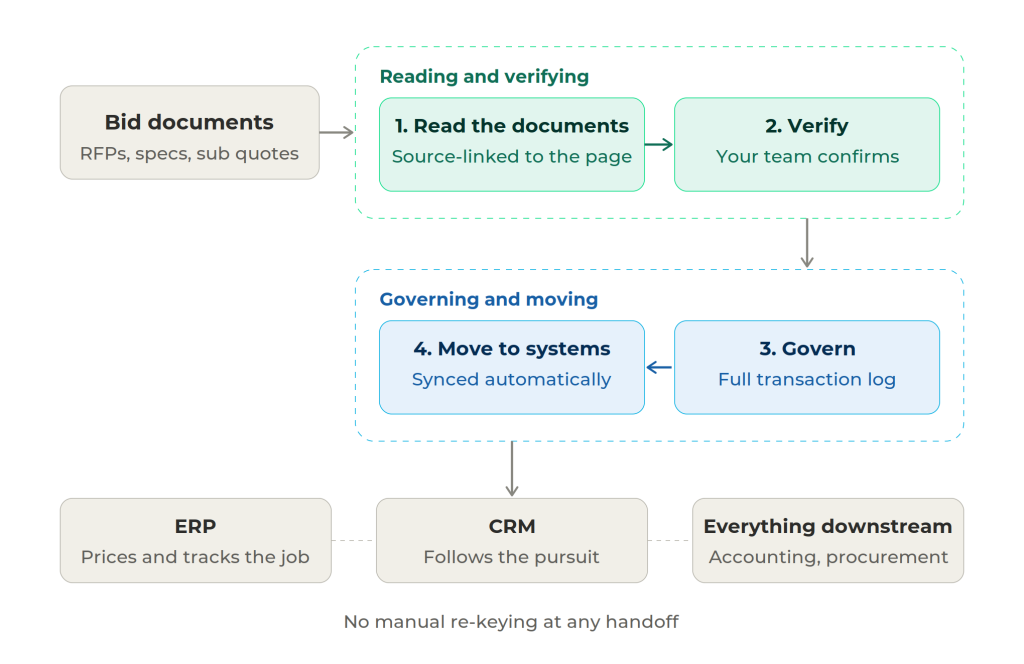
Pivotly was built around that gap. Not as another place to build bids, and not as a replacement for the bidding software, the ERP, or the CRM you already run. It is the connective work those systems assume someone else is doing — one continuous line from the documents that arrive to the records that land in every system downstream. Here is what that line looks like, stage by stage.
1. Reading the documents — The front door
The line starts where the bid does: the RFP, the spec book, the schedule of values, the sub quotes that never quite line up. Pivotly reads them the way a senior estimator reads them, but faster and without the fatigue — pulling line items, scope, and quantities into structured data before the estimator even opens the file. This is the read most bidding software assumes you have already done by hand.
Three things make that read estimator-native rather than generic. Every extracted row is source-linked — traceable back to the exact page and coordinate it came from, so when an owner asks where a number originated, the answer is a location in the document, not a shrug.
Revisions are tracked with full diff detection across bid versions, so a change buried in addendum three does not quietly rewrite a number nobody re-checked. And scope gaps surface before they cost you — the missing line item in Division 23 gets caught while there is still time to catch it.
2. Verifying before anything moves — Human in the loop
Extraction alone is not trust. A number that is ninety-five percent likely to be right is a number someone still has to check, and an unchecked number that moves downstream becomes an error in four systems instead of one. So nothing advances on the strength of the read alone.
The AI does the extraction; your team confirms the calls that matter. That verification step is the point, not an afterthought — it is the difference between data you can put in front of an owner and data you have to spot-check. Every row is accountable before it goes anywhere.
3. Governing the handoff — The audit trail
Once data starts moving between systems, the question stops being “is it right?” and becomes “where did this come from, and when did it change?” Most shops answer that by reconstructing it — pulling up the old PDF, comparing versions by eye, asking who touched the spreadsheet last.
Every handoff writes to a full transaction log instead. Version history, source linkage, and the record of what moved where. When something looks wrong, you find where and when it happened in seconds, not after a three-day investigation. That trail is also what makes the whole line defensible when an owner, an auditor, or your own PM asks how a number got where it is.
4. Moving it to your systems — The data layer
This is the stretch that bidding software leaves undone, and the reason the rest of the line matters. Verified records sync to the systems that need them — the ERP that prices and tracks the job, the CRM that follows the pursuit, the accounting system, the project setup, the procurement list. Automatically, and without a person carrying numbers between screens.
Nothing gets replaced to make that work. The bidding software still builds the bid. The ERP is still the ERP. What changes is that the data arrives in them clean, already verified, already traceable — instead of arriving via somebody’s keyboard at 6 p.m. Contractors who map their data flows this way typically find one or two of these connections eliminate sixty to eighty percent of the manual data movement in the business.
One continuous line, not a stack of handoffs
Read those four stages back and the shape of the thing is the point: there is no seam in it. No export that waits for someone to import it. No verified number that gets re-typed to reach the next system. The documents come in at one end and clean, traceable records land in every system at the other, with a human confirming the calls that need judgment along the way.
That is the part the rest of the market leaves exposed. Bidding software stops at the finished bid. Every other system waits for data to be entered. The gap between them is real work, done by hand, on every bid and every job. Closing it is not a feature bolted onto the end of the process. It is the whole design.
What this changes for the estimator
Close the gap and the workday changes in specific, unglamorous ways:
- Less time spent re-keying numbers that your bidding software already got right — into the ERP, the CRM, and everywhere else they have to land.
- Revisions that carry their own history and their own source, instead of being tracked by memory and marked-up PDFs.
- Fewer transcription errors riding a wrong digit all the way from a spec book into a submitted bid — and a traceable log when something does go wrong, so the fix takes seconds, not a Monday-morning reconciliation.
None of that is about doing the estimator’s job for them. Reading a bid set with judgment, pricing scope, deciding what a number means for this project on this timeline — that is estimating, and it stays with the estimator. The human verification step is the point, not an afterthought: the AI does the extraction, a person confirms the calls that matter.
What changes is where the hours go. Time that was spent moving data by hand goes back into the work that actually wins bids.That is the whole argument for closing the gap. Your bidding software was never the bottleneck. The space between it and every other system was.
Sources
Deloitte Access Economics (commissioned by Autodesk), “State of Data Capabilities in Construction” (2023)
Parseur, “Manual Data Entry Report” (2025)
Construction Industry Institute