
Picture the week before a big supplier review. Your team pulls the purchase orders for that supplier, adds them up, and walks into the room with a number. Then the supplier’s account manager opens with a bigger one, because their sales system counts every order from every site, card, and business unit that bought from them. That gap is a spend visibility problem, and it decides who holds the leverage before anyone mentions price.
Put simply, spend visibility is all about your ability to see how much your company spends, with whom, and on what, in one place and in time to act on it.
Most procurement leaders already have partial visibility into their spend. The rest usually lives in systems your team doesn’t own, and pulling it together by hand takes time you’d rather spend preparing for the negotiation itself.
This guide walks through where your spend hides, what that costs you at the table, and how to build a view you can trust before your next supplier review.
What spend visibility means when you’re the one negotiating
For a procurement leader, it comes down to three questions you should be able to answer in minutes rather than hours.
- How much did we spend with this supplier across the whole company?
- How much did we spend in this category, and across how many suppliers?
- How much of that spend ran through a contract, and how much went around it?
If you can answer all three for your top suppliers and categories, you can negotiate from the full number. If you can only answer them for the spend that ran through purchase orders, you negotiate from a partial number, and the supplier across the table usually knows it.
None of those questions is about how long a request waits for approval or where an invoice stalls, which our procurement audit guide covers. This piece stays on totals and categories, because that’s where your negotiating position gets built.
Why your spend doesn’t sit in one place
That’s not to suggest anything nefarious is going on. Spend scatters for ordinary reasons, and none of them mean your team did anything wrong. Every channel your company uses to pay for things keeps its own records, in its own format, with its own idea of who the supplier is.
- Purchase orders and invoices sit in your ERP or accounts payable system, which is usually the first and only place procurement looks.
- Company cards and purchasing cards carry a long tail of smaller purchases, often with the supplier name shortened by the card network.
- Expense reports hold what people bought on their own and claimed back, filed under whatever description they typed that day.
- Invoices paid without a purchase order arrive by email and get coded by accounts payable, sometimes to a ledger account rather than a spend category.
- Business units and acquired companies may run their own ledgers, with their own supplier lists and their own category codes.
If you’ve followed a single order through the source-to-pay process, you’ve seen how one purchase crosses several systems. Spend visibility asks the wider question of what happens when thousands of purchases do that across every channel at once.
The same supplier also shows up under different names. One system holds the legal entity, another has the trading name, a third has a regional subsidiary, and the card feed has a shortened version that fits in twenty characters. Each record looks like a small supplier on its own, and without spend visibility, none of them adds up to the relationship you actually have.
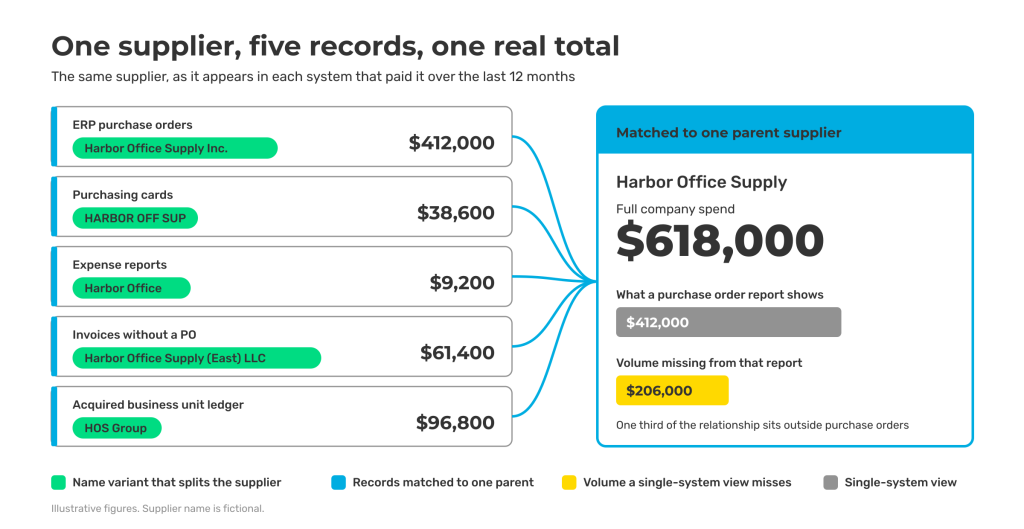 Graphic 1: One supplier, five records, one real total
Categories drift in the same way. One team codes printer toner as office supplies, another codes it as IT consumables, and the card feed files it under a merchant code that means neither. When you total a category, you get whatever share happened to be coded the way your report expects.
And herein lies the problem. `
What poor spend visibility costs you at the table
But what is it really costing you?
The cost rarely shows up as a line item, which is why it’s easy to miss. It shows up instead in negotiations you run from a weaker position than you needed to.
- You negotiate from the smaller number. If a supplier’s full volume earns you a better price tier and you only bring your purchase order volume, you can miss out on substantial savings.
- You can’t consolidate what you can’t count. Supplier consolidation starts with knowing that fourteen suppliers are selling you roughly the same thing, and a fragmented view of your spend hides exactly that pattern.
- Off-contract spend stays hidden. Purchases that went around a negotiated agreement only show up once you can line up card, expense, and invoice data against the contract terms.
- Your analysts rebuild the picture every quarter. Someone exports from four systems, cleans supplier names in a spreadsheet, and hands you a view that’s already a month old by the time you use it.
That last cost is a capacity question as much as anything else. The hours your team spends reconciling exports are hours they aren’t spending on supplier strategy, market research, or preparing for the conversations that actually move your savings number.
How to build spend visibility before your next negotiation
You don’t need a multi-year program to get a view you can negotiate from. You need one period of data, one supplier list, one category list, and a check against what was actually paid. Start with the last twelve months, or with the last quarter if a full year feels too big for a first pass.
Step 1: Pull every payment channel for the same period
Ask for exports from each channel in the list above, all covering the same dates. Include the supplier name, the amount, the date, the description, and whatever code the system uses for category or account, because you’ll need all five to match records later.
Step 2: Give each supplier one name
Group every name variant under one parent supplier and keep the original records underneath so you can still trace each amount back to where it came from. Match on tax ID or remit-to details wherever you have them, since names alone will miss the regional subsidiary and the shortened card entry.
Step 3: Put every line into one category list
Choose one category list and map every system’s codes onto it. A simple two-level list, with a broad category and a subcategory, is enough to start. It’s far more useful applied to all of your spend than a detailed list applied to half of it. If you want cleaner categories going forward, the best place to set them is at intake, which our guide to procurement requirements gathering covers.
Step 4: Check your total against what was paid
Add up your view and compare it with the total that accounts payable and your card programs actually paid out in the same period. If the two numbers don’t match, something is missing or counted twice, and it’s far better to find that now than across the table from a supplier.
Step 5: Keep the view current
A spend analysis rebuilt once a year describes a company that has already moved on. Spend visibility earns its keep when new transactions land in your view every week, already matched to a supplier and category, so it’s ready whenever a negotiation comes up.
Once those five steps are done, a single category stops being a guess and starts looking like a position of strength.
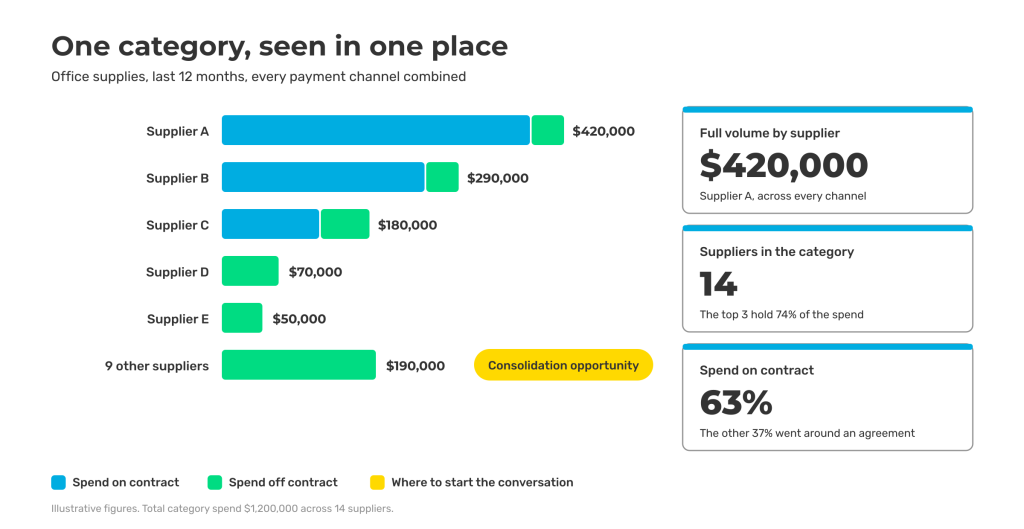
Graphic 2: One category, seen in one place
Using spend visibility to prepare a negotiation
With one view in place, preparation gets much simpler. Before a supplier review, pull that supplier’s full volume across every channel and every business unit, and compare it with the price tiers or rebates in your current agreement.
Before a category sourcing event, look at how many suppliers you use and how the volume splits, since a long, thin tail is usually where supplier consolidation pays off first. Before either conversation, check how much of the spend ran through a contract, because off-contract volume is both a savings opportunity and a compliance question worth answering first.
This is also where spend analysis turns into a weekly habit. When the three questions from the start of this guide take minutes to answer, you can ask them before every conversation that matters.
Keep spend visibility current with Pivotly
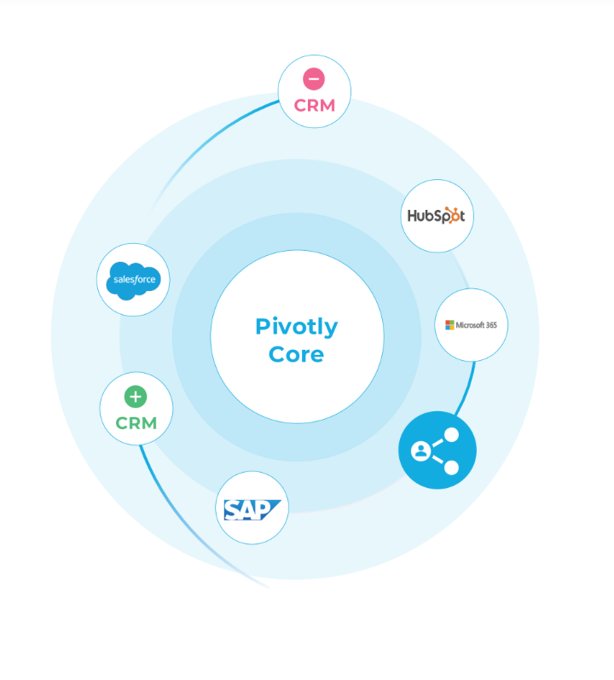
Building the view once proves the point. Keeping it current is where most teams run out of hours, because every step above has to happen again each time new transactions arrive. Pivotly connects the systems you already run, including your ERP, card feeds, expense tools, and invoice inboxes, so every channel lands in one governed view of your spend.
Supplier name variants are matched to one parent, every line is mapped to your category list, and each figure links back to the source record it came from. AI suggests the matches and your team confirms them, so the view stays accurate and every change is logged with who made it.
Your analysts get their quarter back for the work that moves savings, and you walk into the next negotiation with spend visibility across the whole company.
For IT and operations leaders
Everyone can generate an app. Almost no one can run one safely.
One governed place for every app, workflow, and AI action. In your tenant, your data stays yours.
Book an assessment