
Three bids came in this morning for the same package. One is a clean lump sum. Great. One splits material and labor across four lines. Okay, cool. The third is the lowest number on the table, but it also has a strange line item labeled, “Allowance: controls.”
Bid day is Thursday. You already think the low number is not really the low number but now you have to prove it.
Leveling subcontractor quotes means getting all three onto the same footing, so the number you carry is the one that actually wins.
Why no two bids match
No two bids are ever the same, in part because subs quote the way their own business works.
A mechanical contractor who buys the equipment and installs it will price material and labor together. That is how they track cost. A shop that hires out its controls work will carry controls as an allowance. They will not have a real number until their vendor gives them one.
Neither sub is trying to make your job harder. Each one answered your invitation the way their own system produces it.
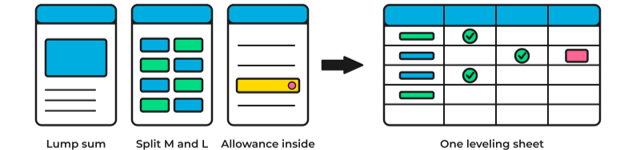
So the mismatch is not going away. You control two things. How much you settle before the bids go out, and how much you untangle after they land.
What it costs when you miss one
A missed line item does not show up on bid day. It hides inside a number you carried. Months later it shows up as a change order nobody planned for. By then the margin is spent, and the only question left is who pays.
The time spent on leveling subcontractor quotes adds up too. Precon teams spend about 13.4 hours a week just looking for data (Autodesk and Deloitte, State of Data Capabilities in Construction). But time is the smaller cost. The bigger one is in the comparison that appeared complete and accurate, but was not. We covered that in full in The ROI of Bid Leveling.
Six things that make the next one easier
- Send the scope breakdown up front. Put your line item list in the invitation to bid. Every gap you close now is one you are not chasing on Wednesday night.
- Build your sheet from your scope list, not from their bids. Start with what the job needs. Then check who covered what. If you build from the bids, you only see the gaps the subs chose to show you.
- Read the exclusions before you read the number. A total tells you very little on its own. Two minutes in the exclusion list tells you more than the price does.
- Treat every allowance as a question. An allowance is a placeholder. Somebody pays the difference later, and it is usually you. Ask what it covers. Ask what happens when it runs out.
- Get clarifications in writing. A yes on a phone call will not survive to buyout. Write the answer next to the line item it fixes, so it stays with the number.
- Reuse one sheet per trade. A sheet built around how a trade is really scoped will hold up bid after bid. Rebuild it from scratch every time and the same mistakes come back.
What you can hand off, and what you cannot
Leveling is really two jobs. It helps to keep them apart.
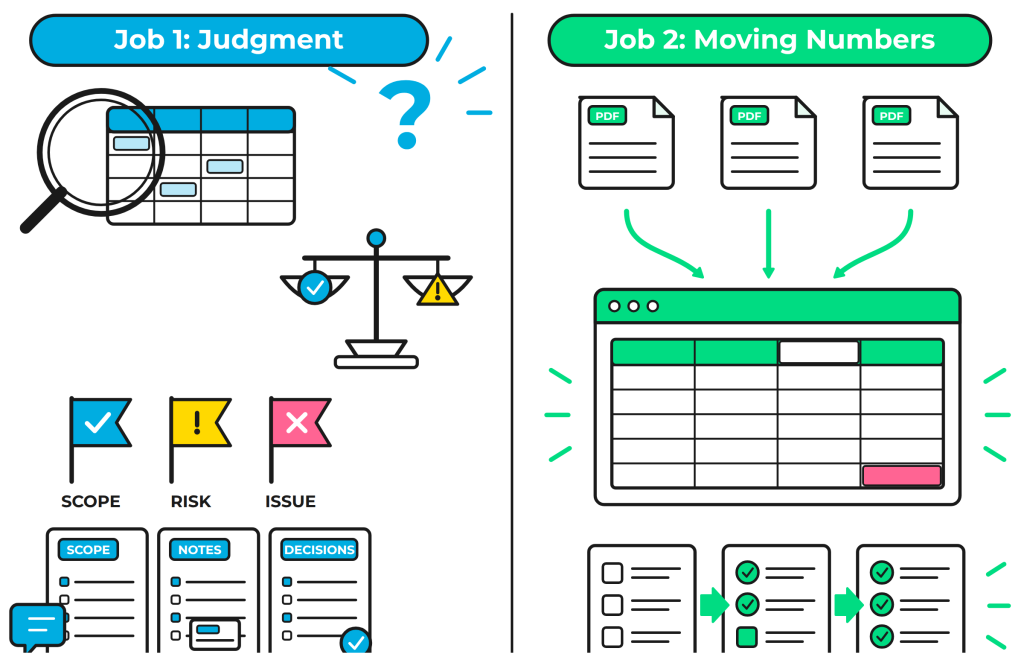
The first job is judgment. Is a $12,000 controls allowance light for this job? Does this sub always leave out roof curbs? Does an 18 percent spread mean somebody read a different drawing? That work is estimating. It belongs to your team and it should stay there.
The second job is moving numbers. Getting three differently formatted PDFs onto the same line items is the same work every time. It does not need a senior estimator at full attention to come out right.
That is the part worth handing off. Every hour you get back is an hour for scope review, sub calls, and the next bid.
Where Pivotly fits
You are still going to open every bid. What changes is what you are doing while you read it.
Pivotly lets you upload them the way they arrived, PDFs, spreadsheets, whatever the sub happened to attach. What you get back is one sheet with the lines matched up and every number tied to the page it came from. When a figure looks wrong, you click it and you are looking at the source, instead of hunting through forty pages to find where that $12,000 came from.
When the leveling is finished, the comparison can move straight into the ERP or project management system you already run on. That means nobody is stuck retyping it at nine o’clock on Thursday night.
Same team, more bids, and a week that has room in it again.
Live webinar · Register or watch on demand
See the full leveling workflow walked through on real bid docs, start to finish.
Access the webinar